NHL save percentage has collapsed to a 30-year low and the reason is not what fans think
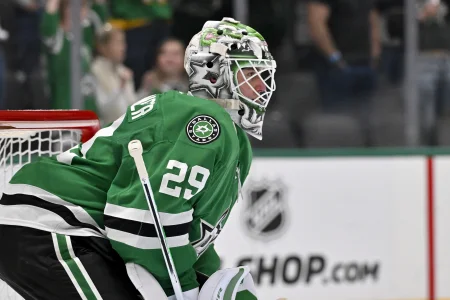
Photo credit: Jerome Miron-Imagn Images
The numbers are hard to look away from. League-wide save percentage has dropped to .896 this season, and goalies like Logan Thompson of the Washington Capitals are not pretending otherwise.
That .896 mark would be the lowest average in the NHL since 1994.
Think about that for a second. Nearly every rule change since the 2004-05 lockout, every crackdown on obstruction, every tweak designed to open the game up, has pointed in the same direction. More goals.
But the story is more complicated than most fans realize.
Thompson, sitting at .912 on the season across 58 starts, put it plainly: players are better, their sticks are better, their shots are harder, and they're a lot smarter about when to pull the trigger.
The league is also averaging just 27.8 shots per game. That is the lowest volume since the hooking-and-holding era of the late 1990s.
And here is the paradox. Fewer shots, lower save percentage. Because the shots that do get through are coming from better spots, on better reads, with far more deception built in.
Dallas Stars goalie Jake Oettinger has lived this contradiction all season. His .900 sv_pct is the worst of his career, and the Stars have gone 49-20-12, which tells you everything about how good their team is in front of him, not how bad he has been.
Oettinger's .900 season puts a number on a league-wide crisis
Oettinger himself pointed to a specific shift in how forwards attack the crease. Puck carriers who would have ripped a wrist shot from the slot ten years ago are now looking for the pass first.
That might be sound offensive hockey. But it is absolutely brutal for save percentage optics.
Retired goalie Martin Biron put it simply: the job was easier when a winger came down the wing and shot. He tracked the shooter and played his angles. Two variables. Now there are four or five.
The equipment side adds another wrinkle. The league has trimmed padding on chest protectors, blockers, and pants to give shooters more of the net. Thompson says the mobility gain is real, but there are specific gaps that no technique can cover.
A softer shot that finds the five-hole through a narrower pad is not a bad performance. It is geometry.
Brian Boucher, another retired goalie, wonders aloud whether .900 is now the new standard of adequacy rather than failure. He used to calculate mid-game how many more stops he needed to hit that mark. The bar may have just been lowered for an entire generation.
Thompson recalled a game between Dallas and New Jersey where Oettinger was pulled after allowing four goals on eight shots. The final combined number: 10 goals on 51 shots, a .803 combined save percentage between the two goalies.
His point was not that the goalies had a bad night. His point was that neither of them had a chance.
With Vasilevskiy at .910 and Luukkonen posting .908 on the season, a handful of starters are still beating the league average by a meaningful margin. But those names are the exception, not the template.
The bigger question, and nobody has answered it yet, is whether goaltending coaches have caught up to the shooting science that forwards have been studying for years.
Also read on Blade of steel :
NHL superstar makes stunning return after years away and it’s turning heads
NHL superstar makes stunning return after years away and it’s turning heads
| POLL | ||
AVRIL 14|81 ANSWERS NHL save percentage has collapsed to a 30-year low and the reason is not what fans think Is a .900 save percentage still an acceptable standard for an NHL starting goalie? | ||
| Yes | 60 | 74.1 % |
| No | 21 | 25.9 % |
| List of polls | ||